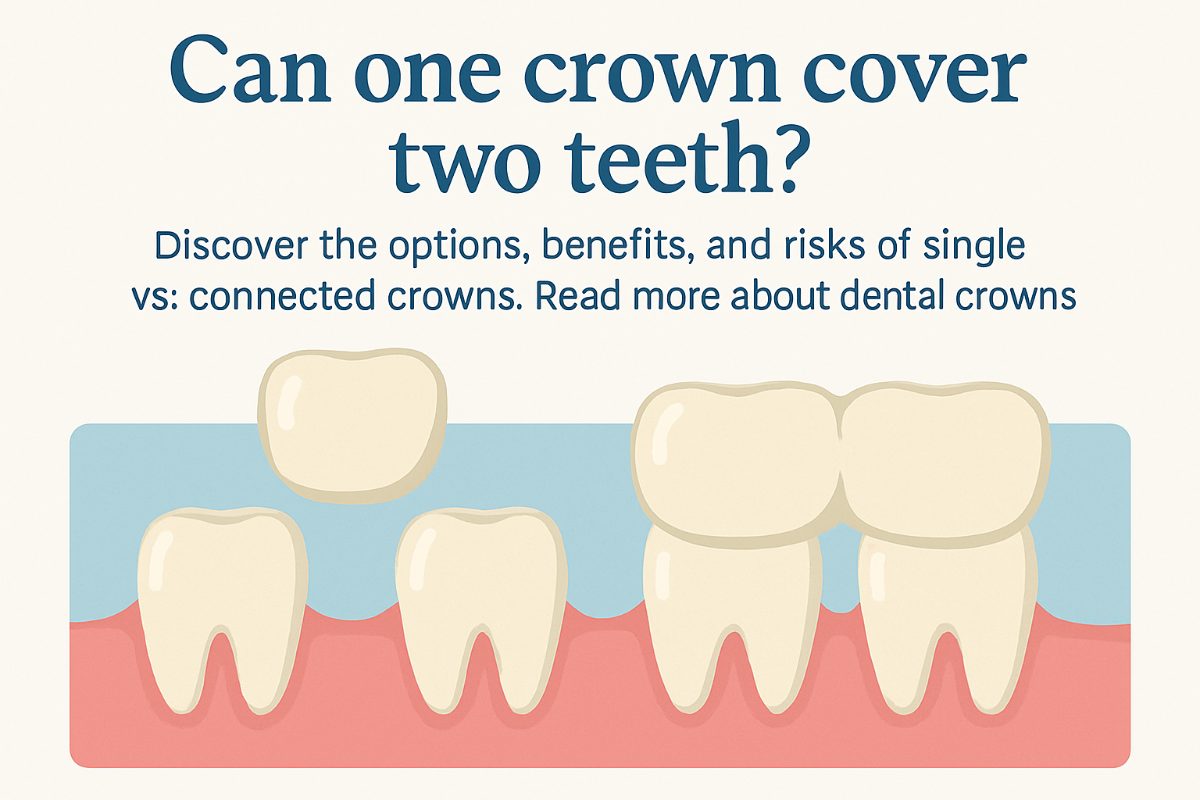
Can one crown cover two teeth? Many patients ask this when they face large restorations, fused teeth, or nearby weak teeth. This article answers that question plainly, explains when a single crown might be used, and reviews safer alternatives. Read on for clear steps you and your dentist can take to find the best long-term fix.
What is a dental crown?
A dental crown is a cap that fits over a damaged or weakened tooth. Crowns protect the tooth, restore its shape and strength, and improve how it looks. Dentists make crowns from porcelain, zirconia, metal, or layered materials. Crowns are most often made for one tooth at a time to restore function and appearance.
Can one crown cover two teeth — the short answer
Short answer: usually no. For two separate, healthy teeth, one crown is not the standard treatment. That said, can one crown cover two teeth in Arlington, TX in rare or special cases. Examples include certain congenital tooth fusions or when a dentist intentionally connects crowns to splint weak teeth. Those approaches have trade-offs and are chosen only after careful evaluation.
When covering two teeth might be considered
Tooth fusion or gemination
Some people are born with fused or geminated teeth, where two dental structures are joined. In those cases, a single custom crown can restore the joined tooth and correct shape or bite. The crown treats the single, unusual tooth structure rather than two normal separate teeth.
Splinting weakened teeth
After trauma or advanced gum disease, a dentist may connect crowns to splint and stabilize adjacent teeth. Connected crowns can help share biting forces and protect fragile teeth. This is a deliberate, planned choice and is not the same as replacing two separate healthy teeth with one crown.
Temporary or emergency solutions
In emergencies, a provisional or temporary connected crown might be used as a short-term fix while a long-term plan is made. These are not meant to be permanent because they can make cleaning harder and raise risk of decay if left too long.
Common alternatives to one crown for two teeth
Most dentists will recommend one of these options instead of trying to cover two teeth with a single crown:
- Individual crowns for each damaged tooth — the most predictable long-term choice.
- Porcelain veneers or minimal-prep veneers for cosmetic fixes when teeth are strong enough.
- Onlays or inlays to preserve more tooth structure when damage is limited.
- Bridges — crowns on neighboring teeth can support a replacement tooth when one is missing.
- Dental implants when a tooth is missing or not restorable.
- Same-day crowns for fast, single-visit restorations when appropriate.
Risks, benefits, and hygiene considerations
Benefits of a connected restoration can include extra stability in selected cases. Risks include harder flossing between teeth, increased chance of decay at crown margins, and esthetic compromises if the shape or color doesn’t match nearby teeth. Long-term success depends on excellent home care and regular dental checks to monitor margins and gum health.
How a dentist decides — diagnosis and planning
Decision steps typically include a clinical exam, digital X-rays, and intraoral scans to view tooth roots and bone. Your bite, gum health, and cosmetic goals are reviewed. A dentist will explain options, risks, costs, and the timeline so you can choose a solution that fits your needs and lifestyle. In many cases, they’ll recommend conservative, single-tooth solutions first.
Type A Dentistry’s approach to complex restorations
At Type A Dentistry, Dr. Sarah Esmail uses digital diagnostics and same-day crown technology to plan conservative, durable restorations. The practice favors solutions that protect tooth structure and long-term oral health. When a connected restoration is the best clinical choice, the team explains why and sets a clear maintenance plan to reduce future problems.
When to schedule an evaluation
See a dentist if you have pain, a cracked or broken tooth, loose restorations, or cosmetic concerns. Bring any recent X-rays, a list of medicines, and photos of your smile if that helps explain your goals. If you’re in Arlington, TX and wondering “can one crown cover two teeth,” book an evaluation to get a clear, personalized answer.
If you want a careful exam and clear options, schedule a consult with Type A Dentistry. We’ll review whether a single crown, connected restoration, or a different treatment is best for your long-term oral health and comfort.