(817) 277-5341


 All Articles
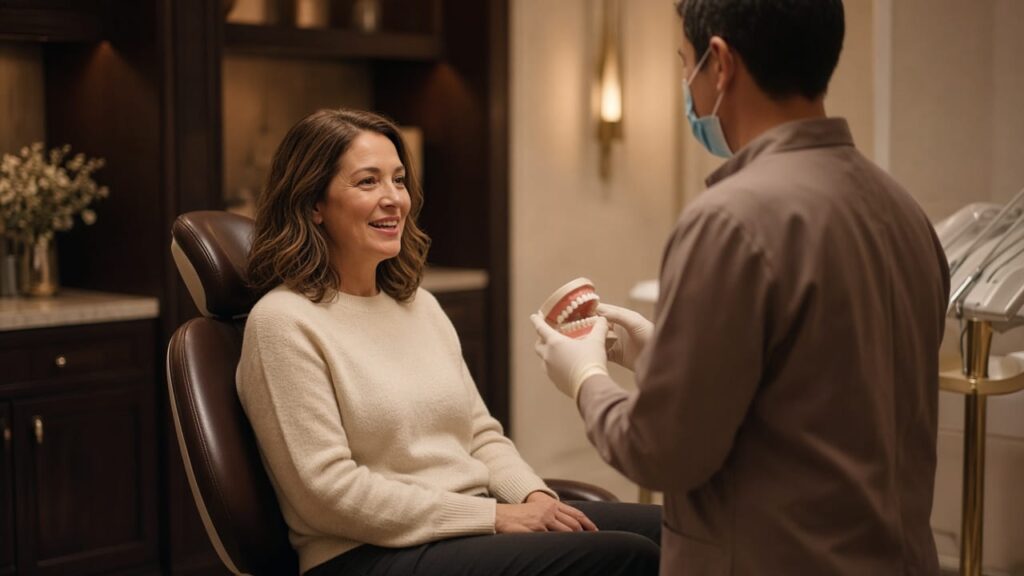
If you have ever cancelled a cleaning because your stomach dropped at the thought of the dental chair, you are in good company. Plenty of adults across Arlington and the Mid-Cities put off care out of nervousness, and there is no shame in it. At our office near UT Arlington, we believe a good dentist for anxious patients starts by listening, going at your pace, and never making you feel judged for how long it has been.
A recently published clinical study adds some useful evidence about one simple comfort tool: distraction. Here is what it found, how to read it honestly, and what a calmer visit can look like.
Why dental fear quietly delays care
Dental anxiety rarely announces itself. It shows up as rescheduling a visit once, then twice, then not at all. A sore tooth gets chewed around. A chipped edge gets ignored. Months turn into years, and the thing you were worried about starts to feel even bigger.
The cost of waiting is usually practical. Regular exams and cleanings are how dentists catch small problems early, and the CDC's oral health resources treat prevention as the foundation of good oral health. When fear keeps you away, small issues have more time to become larger ones that may need more involved treatment.
If this sounds familiar, two things are worth saying plainly. First, you are not behind in a way that deserves a lecture. Second, for many people, the hardest part is simply making the call.
What the new research looked at
Researchers Sidharth Erramshetty, Lalitha Rani Chellappa, and Delfin Lovelina Francis published a single-centre clinical study in the journal Adolescência e Saúde. They wanted to know whether distraction could ease anxiety and physical stress during a dental procedure.
The study included 80 adults having routine tooth extractions under local anaesthesia. They were split evenly into four groups of 20:
- No distraction (the control group)
- Audio distraction
- Video distraction
- Combined audio-visual distraction
The researchers measured anxiety before and after using two self-report scales, the Visual Analogue Scale (VAS) and the Subjective Units of Distress Scale (SUDS). They also recorded systolic blood pressure, diastolic blood pressure, and heart rate as physical indicators of stress.
What the findings showed
To make the numbers meaningful: VAS is typically a 0 to 10 scale, and SUDS is typically a 0 to 100 scale, with higher scores meaning more distress. Blood pressure is measured in mmHg and heart rate in beats per minute.
In the group with no distraction, anxiety went up. Average VAS scores rose from 4.65 to 6.90, SUDS scores rose from 53.35 to 73.50, and heart rate rose from 85.30 to 88.60 beats per minute.
All three distraction groups, by contrast, showed significant reductions in self-reported anxiety and in the physical measures. The largest numerical improvements came from combined audio-visual distraction:
- VAS down by 5.20 points
- SUDS down by 51.75 points
- Systolic blood pressure down by 18.05 mmHg
- Diastolic blood pressure down by 12.00 mmHg
- Heart rate down by 14.90 beats per minute
Video distraction showed the next largest reductions, followed by audio alone. The authors describe multisensory distraction as a possible non-drug adjunct for improving patient comfort.
Reading the results honestly
It is worth being careful here. This was a small study of 80 people at a single centre, and it focused on tooth extractions. One study cannot tell us what works best for every anxious patient, and it does not promise that audio or video will make any particular person feel relaxed.
There are other caveats. The abstract says participants were allocated to groups, but it does not say they were randomly assigned or that anyone was blinded. Anxiety was also measured largely through self-report, alongside blood pressure and heart rate. That makes the results encouraging rather than definitive. The audio tested was also not described as music specifically, though music is a familiar example of what audio distraction can look like.
What the study does support is a sensible, low-risk idea: giving your mind something else to hold onto may make a dental visit feel more manageable. Whether that carries over to fillings, cleanings, crowns, or cosmetic work was not tested, so we would rather say so than oversell it.
In our own experience, distraction tends to sit best alongside other basics: knowing what is coming next, having a way to pause, and feeling that no one is rushing you. That is our view as a practice, not a conclusion from the study.
What to look for in a dentist for anxious patients
Whether you choose our office or another, these questions can help you find a practice that fits:
- Pacing: Will the visit be unhurried, or squeezed between other appointments?
- Communication: Will the dentist explain what they are doing before they do it, in plain language?
- A way to stop: Can you agree on a signal, such as raising a hand, to pause at any time?
- Breaks: For longer visits, can you take a moment to rest and reset?
- Comfort options: Is it okay to bring headphones or listen to something you enjoy? Ask what the office can accommodate.
- Numbing and relaxation: Ask which numbing and relaxation options the office offers and what they involve, so nothing about the process is a surprise.
- Language: Can you talk through your worries in the language you are most comfortable in? If that matters to you, ask about language support when you call.
- Attitude: Do you feel judged when you mention how long it has been? You should not.
For general background on routine care and what happens at a visit, the American Dental Association's consumer site, MouthHealthy, is a good place to start. The National Institute of Dental and Craniofacial Research also publishes plain-language oral health information, which can take some of the mystery out of a visit.
At Type A Dentistry, our promise is judgment-free, meticulous care. Dr. Sarah Esmail, who leads our practice, would rather hear what worries you before she picks up an instrument. Tell us whether it is needles, sounds, feeling out of control, or a past bad experience, and we will talk through your comfort preferences before any treatment begins.
Getting overdue care started in Arlington
If you have been searching for a dentist for anxious patients in Arlington, a simple first visit is the gentlest way back: a comprehensive exam and cleaning, a chance to meet the team, and an honest look at where things stand. There is no pressure to decide on anything that day. We care for the whole family, and we see neighbors from Pantego and Downtown Arlington as well as UT Arlington students and staff who want a calm first appointment close to campus.
Once the chair feels less intimidating, some people are ready to talk about smile goals too. That might be whitening ahead of holiday photos, or a longer-term conversation about veneers or Invisalign, which take months rather than weeks. Either way, there is never a need to decide at a first visit.
Cost worries can be a source of anxiety on their own. Many dental plans run on a calendar year, so it is worth checking your plan's benefit period before the year ends. Our insurance and financing page explains how we help. We accept most dental insurance and offer third-party financing. If you do not have insurance, our in-house membership plan is designed for you, and we are glad to explain costs before treatment begins.
Some patients come to us from Grand Prairie, Mansfield, or Fort Worth because they would rather travel a bit for an office that feels right. We know a stressful drive can add to pre-appointment nerves. If that sounds like you, ask about a time that avoids I-30 rush hour so you can arrive unhurried and calm.
Where to find us and next steps
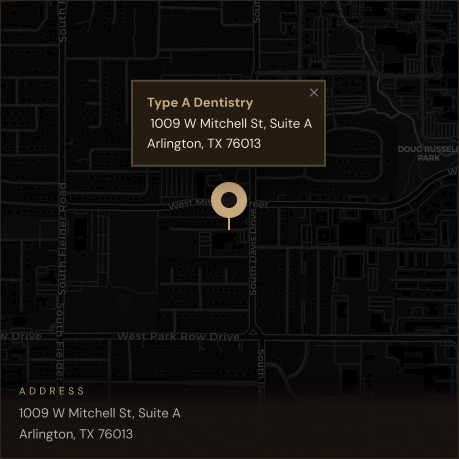
You can find Type A Dentistry at 1009 W Mitchell St, Suite A, in Arlington, near the UT Arlington campus. Look us up on Google Maps, Apple Maps, or Yelp to see our location, get directions, and read what other patients have said about their visits. Reviews can be a helpful way to gauge whether an office feels warm and unhurried before you ever step inside.
If you would like guidance on your own situation, whether that is a long gap since your last visit, a fear of a certain procedure, or questions about cost, contact our team and we will help you plan a first visit that feels comfortable.
Frequently asked questions
Is there a dentist for anxious patients near Arlington who will not judge me for putting off care?
Yes. At Type A Dentistry, judgment-free, meticulous care is our stated promise, and we welcome patients who have been away for a long time. We start with a conversation about what worries you and move at a pace that feels right. If you would prefer to talk it through in a particular language, ask us about language support when you call.
Does listening to audio or watching a video really help with dental anxiety?
The research suggests it can. In a study of 80 adults having tooth extractions, audio, video, and combined audio-visual distraction all reduced self-reported anxiety and physical stress measures, with the combined approach showing the largest drop. It was a small, single-centre study, though, so distraction is best seen as a possible comfort aid, not a guarantee.
What should I do if I do not have insurance and I am nervous about the cost too?
You have options. We offer third-party financing and an in-house membership plan for patients without insurance. We are glad to explain costs before treatment so there are no surprises.
If fear has kept you away from the dentist, a small first step is enough. Book a consultation with Dr. Sarah Esmail and our team in Arlington, tell us what makes you nervous, and we will build the visit around your comfort.